
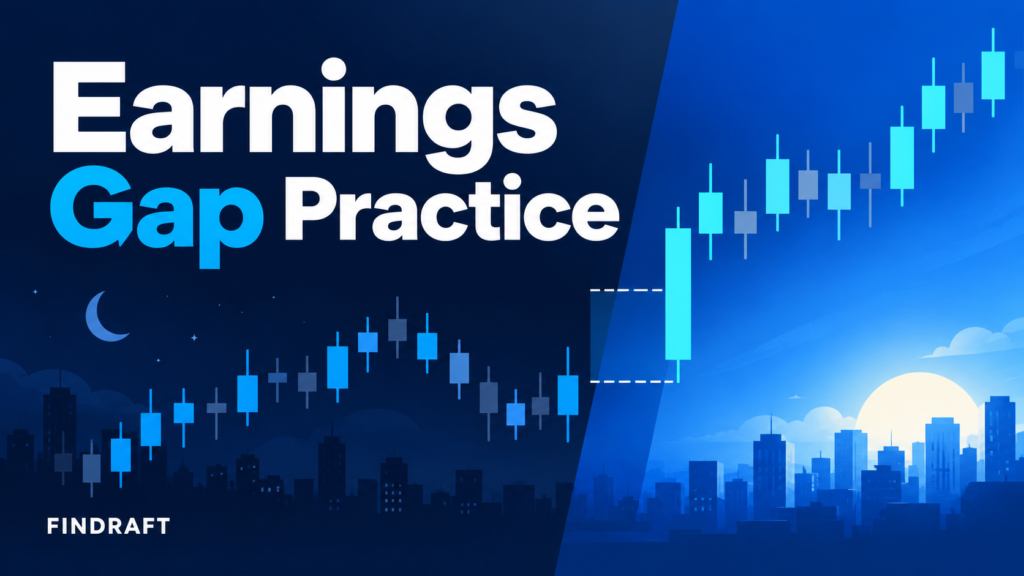
A share can open far from its previous closing price after an earnings announcement. That gap creates a useful learning exercise, but it does not establish a repeatable trading edge. The aim of earnings-gap paper practice is to document what you knew before the session and how execution assumptions changed the outcome.
Build the observation sheet first
Choose a company with a dated, publicly available results announcement. Record the previous close, announcement time, next-session opening price and source timestamps. Separate information published before the opening from commentary written afterwards.
Write a hypothesis before seeing the full day. For example, you might study whether a gap holds above the opening range. Define the range duration and the rule in advance so the exercise cannot be rewritten to fit the chart.
Define a hypothetical risk budget
Suppose a fictional share closed at ₹500, opens at ₹525 and offers a possible practice entry at ₹528 with an invalidation level of ₹520. The planned price risk is ₹8 per share. For an illustrative ₹800 risk budget, the simple size is 100 shares before costs and execution buffers.
This calculation is not a recommendation or a promise that an exit will occur at ₹520. A gap through the level, thin liquidity or a trading halt can make realised losses different.
Record realistic execution
Use observable quotations where available. A candle touching a price does not prove your entire order would have filled there. Include a clearly labelled slippage assumption and applicable transaction-cost estimate.
Record situations where no practice entry occurred. Excluding missed or invalid setups can make an exercise look better than the rule actually performed.
Review process separately from outcome
Compare the planned entry, invalidation and actual simulated action. Note whether you chased the opening move or changed rules after a loss. Evaluate multiple observations before making any claim about the approach.
Use a paper environment such as TradeDraft for virtual practice and keep a manual record when a required data field is unavailable. Simulation cannot reproduce every real-market fill, cost or emotional pressure.
Should I assume every earnings gap continues?
No. Gaps can continue, reverse or become range-bound.
Is one successful paper trade enough evidence?
No. It is one observation under specific conditions, not proof of future profitability.
Explore the FinDraft learning programs to strengthen market foundations before moving to more complex exercises.
Official learning references
Educational content only; not personalised investment advice or a recommendation. Investments and trading involve risk. All numerical examples are hypothetical. FinDraft provides independent preparation; official NISM examinations and certifications are administered by NISM.